
About our data
Updated July 31, 2026
Stock Analysis has global coverage for stocks and ETFs, with over 130,000 tradable symbols. This includes all the main U.S. exchanges: NASDAQ, NYSE, CBOE, and OTC Markets.
To learn more about our data, visit our Data Sources page.
Financial statement data providers
Stock Analysis uses several data providers for financial statement data (Income Statements, Balance Sheets, Cash Flow Statements) and financial ratios.
These are the key differences between them:
| Data provider | Update speed | Coverage | History | Accuracy |
| S&P Global | Hours after earnings | Global | 10 Years | Very High |
| Fiscal.ai | Minutes after earnings | U.S., Canada, & Europe | 20 Years | Very High |
| Nasdaq Data Link | After 10Q/10K filed | U.S. Only | 30+ Years | Very High |
| Financial Modeling Prep | Varies | Global | 40+ Years | High |
S&P Global Market Intelligence is the default data provider for the site due to its enterprise-grade data quality, accuracy, and fast updates after earnings releases.
Their data is widely considered to be the gold standard of data accuracy.
However, there are two limitations to how we can use S&P data:
- We can only show 5 years of financial history for free users and up to 10 years of history for paid subscribers.
- S&P Global does not allow downloads.
For these reasons, Fiscal AI — an enterprise-grade data provider that updates within minutes after earnings and allows downloads — is the default data provider for financial statements, though S&P is still an option.
Selecting a provider
You can select the data source from a dropdown above the financial statements, like so:
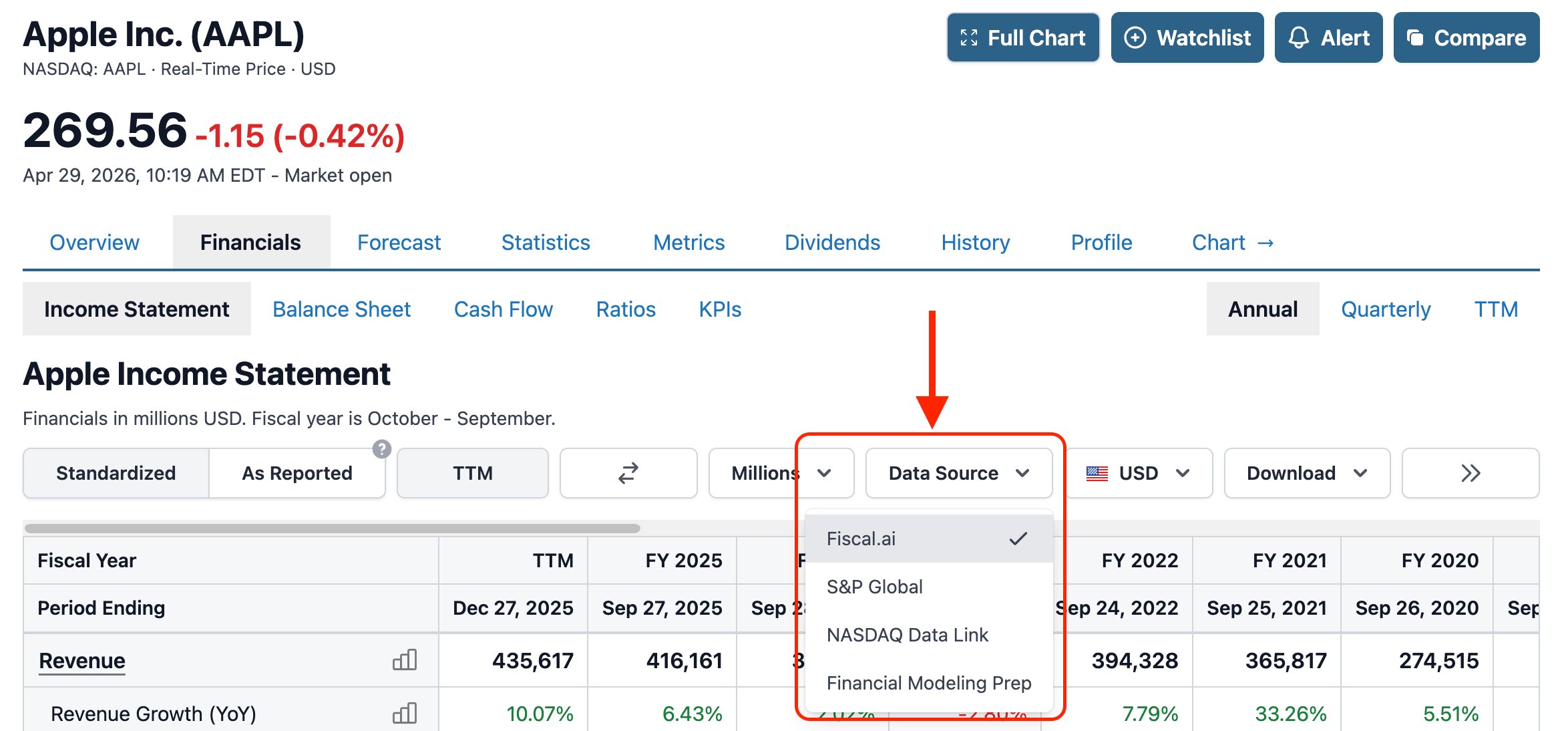
You can find more info about our financial sources, their limitations, and downloads on this page: Financial Sources.
Data quality commitment
We are committed to showing the highest-quality and most accurate data possible. If you see any mistakes or inaccuracies, please send a message via our support form.
Data disclaimer
All data shown on this website is for informational purposes only and should not be relied upon to make trading or investing decisions.