
Thanks, and welcome back to another session here at Oppenheimer's 35th Annual Life Sciences Healthcare Conference. I'm Leland Gershell, one of the analysts on the Biotech Equity Research Team, and very delighted to have with us Soleno Therapeutics as our next presenting company. On behalf of Soleno, we have Jim Mackaness, who is the company's Chief Financial Officer. As many of you know, Soleno has been very focused on bringing new therapies for Prader-Willi syndrome to market. It has DCCR currently in FDA review, so look forward to hearing on that and other activities, and with that, I'll turn the podium over to Jim, and by the way, feel free to lob in questions. I will do my best to ask those on your behalf toward the end of the session. Jim, please go ahead.
Thank you, Leland, and thank you, everybody, for joining us today. As Leland mentioned, I'm Jim Mackaness, the CFO at Soleno Therapeutics. We're based here in Redwood Shores in California. We have about 120 employees, and we're focused on a single asset that's DCCR, diazoxide choline extended-release tablets, for the treatment of Prader-Willi syndrome. We submitted our NDA in the middle of 2024, and it was accepted to file, and we have a PDUFA date of March 27th of this year. DCCR has extensive IP protection, three families of patents being prosecuted and issued in all major geographic markets. DCCR also has orphan designation in the U.S. and E.U., and breakthrough and fast track granted here in the U.S. PWS is a market, as we think, is a very compelling market. We think it's larger than $2 billion in the U.S. and strong market opportunities overseas as well.
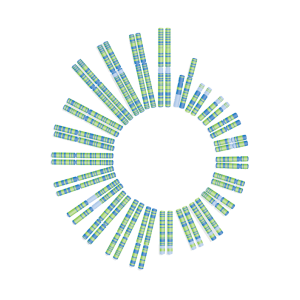
We find ourselves in a very healthy situation at the end of the year. We had $318 million of cash and cash equivalents, etc., to allow us to execute on our strategy. Prader-Willi syndrome itself is a complex rare genetic disorder. It's due to the loss or lack of expression of genes on chromosome 15 and has a prevalence rate of about one in 15,000. The key element of Prader-Willi syndrome is hyperphagia. This is an insatiable desire to eat. It's not like you and I might experience when we feel hunger, where we might eat the rest of the pizza, one pizza. This is where folks will eat one, two, three, four pizzas. They will eat things like frozen chicken if it's left out. They'll rummage through trash for food. They'll eat dog food, even non-food items.
And if they're not supervised, the risk is they'll end up with stomach rupture or choking and death. So, people living with PWS require supervised care for the extent of their lives, typically living with families, and as they go into adults, they may end up in group homes. They do require, as I said, constant monitoring, the creation of food secure zones, so locks on refrigerators, locks on cabinets. And the burden on caregivers is extreme, higher than measured, for example, with caregivers looking after people with Alzheimer's, and siblings often exhibit moderate to severe PTSD. So, a very, very challenging situation. And we have an opportunity with DCCR to be the first to market for addressing the hyperphagia. And we believe there's an opportunity for DCCR to become a foundational therapy for patients with PWS. DCCR itself was intentionally created.
It is the choline salt of the parent molecule, diazoxide. It was chosen to improve solubility. The formulation developed allows for extended absorption throughout the GI tract and can be dosed once daily to achieve stable intraday circulating drug levels, and the circulating drug level is what we think allows DCCR to provide the therapeutic response that we're seeing in our clinical trials. The mechanism of action involves around the KATP channel, the potassium ATP channel, which is found in tissue sites throughout the body, noted here on the right-hand side, so in the hypothalamus, it operates with the NPY neuron and results in the reduction of hyperphagia. It also activates in the DMV neurons, improving insulin sensitivity. In the adipocytes, we see reduction in fat mass, and in the pancreas, we see increased reduced insulin secretion.
We've been looking at DCCR through a number of clinical trials, notably a phase 3 trial that was conducted in 2020, C601, as it was known, DESTINY PWS. It was a multi-center randomized double-blind placebo-controlled trial involving 127 patients who enrolled and 120 completed, and they then went on to enroll in C602, an open-label extension. We read out the top-line results. You can see in the middle column, these are top-line results that came out in June of 2020, and what you'll notice is the primary endpoint was not statistically significant. The primary endpoint in these trials involves the HQCT. This is the hyperphagia questionnaire for clinical trials. It's a nine-question questionnaire involving a score of zero to four, so the most extreme score is 36. Caregiver given a two-week lookback.
So, as I said, the results came out in June of 2020, and the primary endpoint was not statistically significant, although we did observe in the two more objective endpoints statistical significance. As we continue looking at these results through July, August, September of 2020, we became much more aware of the impact of COVID, along with all of us, on the impact of all of our lives, and the FDA was cautioning sponsors to be careful about COVID impact on clinical trials, and we're guiding companies to use a March 1st cutoff date to basically have a pre-COVID window, so we re-ran our results for March 1st, 2020, and that's the right-hand column, and you'll see there that we had statistical significance on the primary endpoint and the three secondary endpoints.
And so, we took this information into the FDA, and at this time, the FDA explained that they thought there could be an artifact, and they were guiding us to do an additional controlled trial. We said that that was going to be challenging because COVID was still going, and recruiting for rare diseases was always a problem. And so, we offered to do a comparison with our open label patients in a comparison to PATH for PWS. PATH is an ongoing study evaluating the natural history of subjects with PWS. So, we used match patients, and we had an independent CRO do a statistical comparison of DCCR to PATH. The following slides give you an indication of some of the results that we're able to see from this study.
Firstly, on the left, you'll notice that for those patients in the open-label study who'd been on drug for up to 52 weeks, there's a continued improvement from the benefits of DCCR. And as I mentioned, the HQCT scale runs from zero to 36, with an average of 21 for the patients enrolled in the study. And you can see on average, these patients were improving by 10 points. Physicians will tell you that improvements of one to two are meaningful in this patient population. So, 10 points is very meaningful to the families and the patients. On the right-hand, you can see the results from 26 and 52 weeks. PATH's in the blue, DCCR in the green, and you can see a significant improvement of those on DCCR compared with those in PATH.
If we look at the behavioral domains, there are six behavioral domains that are measured as well for patients after one year, all statistically significant improvements in the behavior domains. Again, comparing DCCR to PATH across the same behavior domains, you'll notice again the drastic improvement for those on DCCR compared with people on PATH. Left-hand side here looks at weight. Weight isn't something we get too focused on because you have to remember for a lot of these patients, they come into the trials at the age of 10, 11, 12, so they're pre-puberty, and you'd expect them to put weight on as they continue to grow. But what you're really looking for is lean muscle mass to be added.
And what you'll notice on the left-hand side is that less weight for those on DCCR, and on the right-hand side, you'll see that it's more concentrated towards lean muscle mass. Looking at some of the hormonal parameters, again, after 52 weeks on drug, statistically significant improvements across all measures. A comment on the safety profile. As I mentioned, diazoxide, the parent molecule, has been around for 40 years, so there's a well-known safety profile, and we're seeing that DCCR generally consistent with prior experience. The most common adverse events are hypertrichosis, hirsutism, peripheral edema, and hyperglycemia. Most were grade one or two and no grade four. This slide just gives you a visual impact of what's happening to those folks on DCCR. After 52 weeks, you can see a dramatic improvement in body composition, particularly lean muscle mass.
So, at this stage, as I said, we've gone back to the FDA, and we've shown them the open label and PATH results. And the FDA came back, and they said, "Okay, we would be interested in more controlled data." So, they weren't, let's say, looking for a new clinical trial. And we came back and proposed that we could do a randomized withdrawal phase on the C602 patients. In our conversations backwards and forwards with the FDA, they acknowledged that the data from the proposed randomized withdrawal would potentially suffice for an NDA submission. And so, we took the patients who were on C602 and put them into the randomized withdrawal period. 77 patients were enrolled, and at the end of the randomized withdrawal period, they then continued on C614, again an open label extension.
We were able to read out the results in September of 2023 on the randomized withdrawal phase, and as you can see, strong statistical significance again on that HQCT questionnaire, so 0.002. Further indication of the efficacy shows in this slide where there's a separation from those patients who went on to placebo, and they start to worsen. Weeks four continue to worsen, eight, 12, all the way through to 16, while those on DCCR remain more stable. These results, if you look at the nine questions, were spread across all questions. There wasn't one question that was really driving the results. Consistent improvement or worsening for placebo compared with DCCR in the randomized withdrawal phase. Trending happening on the secondaries and trending across all domains, so again, evidence of the placebo patients worsening compared with the stability of staying on drug.
Weight, even though I mentioned it's not necessarily something we put at the forefront, but you'll notice that significant weight was put on by those that went on to placebo and a worsening of their BMI scores. So, as far as the regulatory status goes, we did receive breakthrough. As I said, recently, we submitted the NDA, as I mentioned, in June of 2024. The NDA was accepted in August, granted a priority review. We are not aware of an advisory committee at this stage, and we're now looking at a March 27th of this year for the PDUFA. We continue to have great support within the scientific community and patient advocacy groups. Growing body of clinical evidence is presented at medical and scientific conferences. There's been independent town halls that are available on YouTube showing the support from parents of people living with PWS.
When we did our NDA submission, the PWS Advocacy Coalition submitted a petition with over 14,000 signatures requesting the FDA provide priority review, which they did. The FDA has also been at the PWSA USA event for a patient-focused drug development meeting. I did mention early on that we believe there's extensive IP protection on DCCR. In the middle, you'll see us referencing our composition of matter. This has a 20-year life through the end of 2026. We think there's potential for patent term adjustment, and ultimately, if we chose patent term extension, that could extend the life through 2034. There's also some method patents that might be useful as well, depending on how the label reads out. Turning our attention to the commercial side, we think this is a very, very compelling opportunity. The diagnostic rate for people with PWS is very high.
About 85% of diagnoses are made within the first year of life. We've done extensive claims analysis ourselves, and we have a line of sight on 10,000 patients with PWS, and we see this as a very concentrated call point. When we draw back and we look at the HCPs, we see approximately 300 HCPs being the primary treaters for 2,000 PWS patients and influencing a further 2,000, so focusing on the 300 allows us to get access to the 4,000 of the 10,000, and then there's other HCPs we'll be focusing on beyond that. When we look at the PWS market, one of the things we do is we stratify it by age. We look at those that are younger than 25, older than 25. A little bit of that's driven by insurance.
You're on your parents' insurance less than 25, and then you tend to be an adult into different situations. For the younger patients, this is where the onset of hyperphagia happens, increasing disruption in the lives. Caregivers and families are actively engaged, and the majority live within the family, with the primary caregiver being a healthcare provider, the pediatric endocrinologist. Transitioning to adult, now you sort of find that maybe these folks will end up in, as I mentioned, the group homes. They will typically be serviced by adult endocrinologists. So, that'll be a little bit of a different focus for us to address that part of the market opportunity.
When we talk to caregivers and KOLs, the definition that they provide for something that would be very, very meaningful for this community would be something that has a significant impact on hyperphagia, something that comes across with durable improvement in cardiometabolic and body composition, reduction in PWS-related behaviors, and well-tolerated safety profile, and we think at this stage that DCCR is able to deliver on those requirements. Our pathway to success for the U.S. launch is going to be based on the robust clinical program that we have, five years of clinical data. We're focusing on analytics to map the TAM. We're doing account profiling, hiring the teams. We've brought on most of the commercial team at this stage, just looking to fill out the rest of the sales force.
Comprehensive access strategy, being working with the payer mix to understand exactly the mix between Medicaid, Medicare, and commercial, and obviously continue to have a great relationship and invest time with the stakeholders, being patient advocacy groups, caregivers, and KOLs. We've been making great progress over the last 12 plus months to build out the infrastructure and programs to commercialize DCCR. We've got the supply chain in place. As I mentioned, working on market access. Patient service programs are coming up and running. Medical affairs is in place. Marketing, we've been working on disease state education and preparing for branded marketing. Hiring the whole team, as I mentioned, really just a couple of few hires left to go. Patient advocacy continues to be an area of focus, and we have the necessary drug safety programs ready to go. Outside of the U.S., we think there's also a compelling opportunity.
Turn the attention to Europe, for example. We've confirmed high unmet need. We're working with a lot of the thought leaders over there. Estimated to be about 9,500 diagnosed PWS in the E.U. and in the U.K., so very, very similar to the U.S. And our plans are to submit an MAA in the first half of 2025. Last slide just wraps it all up, saying, as I mentioned, that we believe we have a strong balance sheet to execute on our strategy, $318 million of cash equivalents and securities. And for those that are interested, pro forma shares outstanding of about 54 million. And I think that wraps it up. So, thank you very much. And Leland, back to you.
Great. Thanks so much, Jim. Terrific updates. A few questions for you.
So, you know, with respect to lack of an AdCom at this point, you know, I think people are obviously focused on any interactions you may be having back and forth with FDA. Want to know if you can get into any detail around where you may be in the process. You know, are you approaching labeling discussions, so forth?
So, we're keeping our standard refrain of not really commenting on the specifics of any back and forth, but just to say that we continue to sort of have an engagement that we think is constructive.
Okay, good. And in terms of the data, obviously, we've seen, you know, a great spread of data from the randomized withdrawal and also from some of the other endpoints in the original phase III.
You know, I guess some critique of the RW is on the, you know, BMI weight sort of axis of things. And I know that, you know, from speaking with KOLs, it's really more of a hyperphagic issue than it is a weight issue. And I think, as you alluded to, you know, weight can be fairly well controlled through behavior control and modification and, you know, food security and so forth. Do we have confidence that the agency shares that view as well, to the extent you can speak, I guess, on behalf of the FDA, to whom we can't really ask questions directly?
I think to your point, it's very hard to speak on behalf of the FDA. I think we would just remind people, as you did yourself, which is the hyperphagia is to us, the, you know, is the measurement that it's focused on.
We felt that the populations within the randomized withdrawal were equally balanced around the hyperphagia. We feel confident that that's the right way to look at it.
Okay. Pricing, $340,000-$350,000, is that a reasonable range for us to be thinking about in terms of where you'll be pricing DCCR?
You know, the range that we've provided people over the extended period of time is to look at the Amylyx of the world at the low end, sort of like $150,000. Daybue would be the higher end of the range. As you know, that's maybe up in the $540,000s. I think you're focusing on the Imcivree and Skyclarys around $360,000-$370,000. It's definitely within that ballpark. We are spending a lot of time focusing in on that.
And we do anticipate that it'll likely be weight-based pricing when we get there, because it's weight-based dosing.
Right, absolutely. And in terms of the consensus numbers right now that are out there for, you know, your first year, right, assuming approval kind of around the time of the PDUFA, are you guys comfortable with those? Would you see those as being maybe a bit aggressive, given that maybe models haven't been adjusted for the change in the PDUFA date, just gathering your thoughts?
Yeah, I think you raised the comment that we have, or the question we have, which is most analysts, I think, put their models together back in Q3 when there was a PDUFA date of December. I think, you know, what we've consistently communicated is that when we get the approval, assuming we get the approval, you know, we'd anticipate the first launch after that.
We've still got to basically flow the product through from the final part of finished goods and manufacturing through to the 3PL, and then into the specialty pharmacy. You know, we've got to get the reps into the field and connected with all the KOLs and the various physicians. So, you know, generally speaking, the first quarter is likely to be a bit of a wash, and then starting to see that ramp happen in the second and third quarter after that.
Right. So, we would probably expect product to be in market kind of late April, May timeframe, assuming approval around late March?
That seems sensible. Yeah.
Good. And any issues with supply of the product at this point?
No. We continue to work with the partners we've had all the way along, so that's in very good shape.
Did you say that you had inspections, pre-approval inspections already?
I know Anish has referenced that there have been inspections generally along the way, and no issues have been raised.
Great. And then just thinking forward, there are obviously other conditions you could develop DCCR in. Just maybe, Jim, if you could just maybe walk us through your thoughts about next opportunities.
Yeah, I think the way we normally phrase it is there's two logical buckets for us to focus on next, if you like. There's other rare diseases that have hyperphagic conditions, SMS and Fragile X, I hear typically the ones that we would highlight. And then the glycogen storage diseases, where diazoxide historically has been used, and this would be a better opportunity for it. So, those would be two logical areas for us to explore further.
Great.
We look forward to more there, and obviously to the hopeful approval for DCCR. So, thanks very much, Jim, for providing the update, and thanks to everybody who tuned into this session with Soleno. Hope everyone has a terrific rest of the conference.
Thank you, Leland.