
The 6 Best Options Analysis Software and Tools in 2026

Day and swing trading is extremely difficult, and trading options only adds another layer of complexity.
But the right tools can make things a lot easier.
Whether you need...
- A platform for researching options,
- An options-focused brokerage,
- An options alert service,
- Or something else,
...there are dozens of tools, apps, and software to choose from.
In this article, I'll guide you through six of the best softwares and help you find the perfect solution for your options trading.
Summary view
- Best overall: Stock Market Guides
- Best for options market research: Market Chameleon
- Best brokerage for options trading: tastytrade
- Most advanced options trading brokerage: thinkorswim
- Best for real-time options market activity: LiveVol
- Best options API: IVolatility
Disclosure: Some of these are affiliate links. We may receive compensation if you take action through them.
Bonus: At the end, I included a few of my favorite quick-reference tools that didn't quite make the main list but still deserve to be mentioned.
1. Stock Market Guides: Best overall
- Category: Alert service & trade scanner
- Rating:
- Cost: $69/month
Stock Market Guides is a stock and options trade alert service that was built based on seven years of backtested data, research, and analysis.
The brains behind the operation: Eric Ferguson.
Ferguson is a Stanford graduate with a degree in economics. After teaching himself to code, he spent several years performing backtests to find strategies with historically profitable edges.
From there, he built a software to alert him anytime a trade sets up based on one of those strategies.
After using the software for several years on his own, Ferguson decided to turn it into a web-based platform and make it available to other traders. He named it Stock Market Guides.
Here's an example alert:
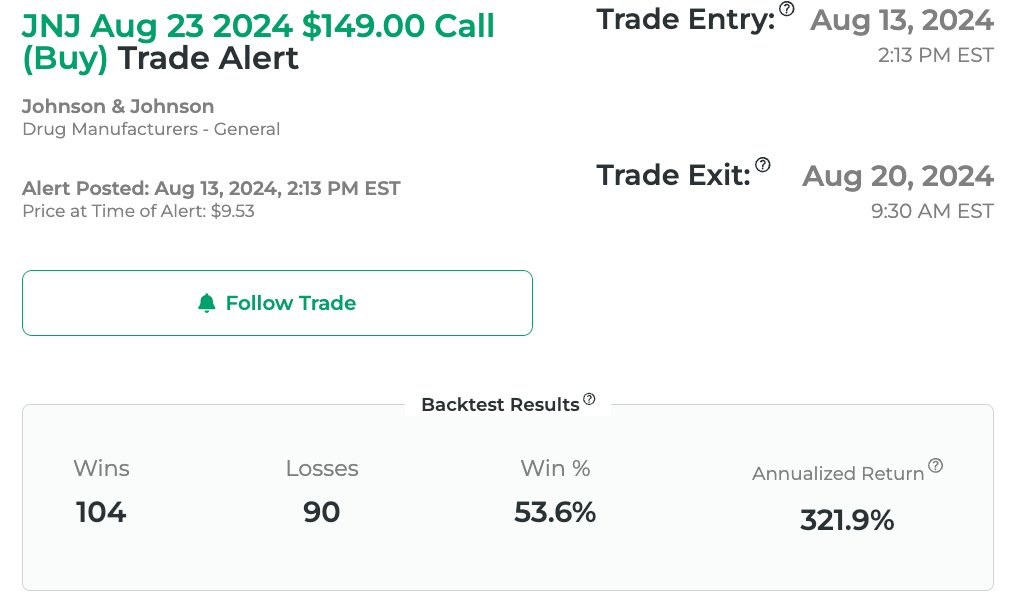
As you can see, this alert was triggered on the “Base Pullback” strategy. When JNJ triggered that strategy in backtests, the trade was a winner 53.6% of the time and generated an annualized return of 321.9%.
Not only does Stock Market Guides give you trade alerts (which is why it's also our top ranked options alert service), but it also gives you access to the actual scanner technology beneath those alerts. This way you can filter on only the trading strategies, stocks, contract prices, win rates, or other criteria that are most important to you.
You're likely interested in options analysis software to find profitable trade setups. As you can see, Stock Market Guides does the heavy lifting for you, with no coding or backtesting required
Disclosure: This is an affiliate link. We may receive compensation if you take action through it.
2. Market Chameleon: Best for options market research
- Category: Research and analysis platform
- Rating:
- Cost: $99/month
Market Chameleon is the best platform to get a wide range of analytics, research, market trends, options flow, screeners, strategies, P/L calculators, and more.
The website, although outdated, is fairly intuitive and easy to navigate. As long as you're not a complete beginner to options, you can expect to become familiar with all the relevant information on the platform in the first 20–30 minutes.
I sell options, and frequently used Market Chameleon's “Buy-Write” search to quickly compare a handful of stocks' call premiums, prices, and IVs in order to find the best risk-reward trades:
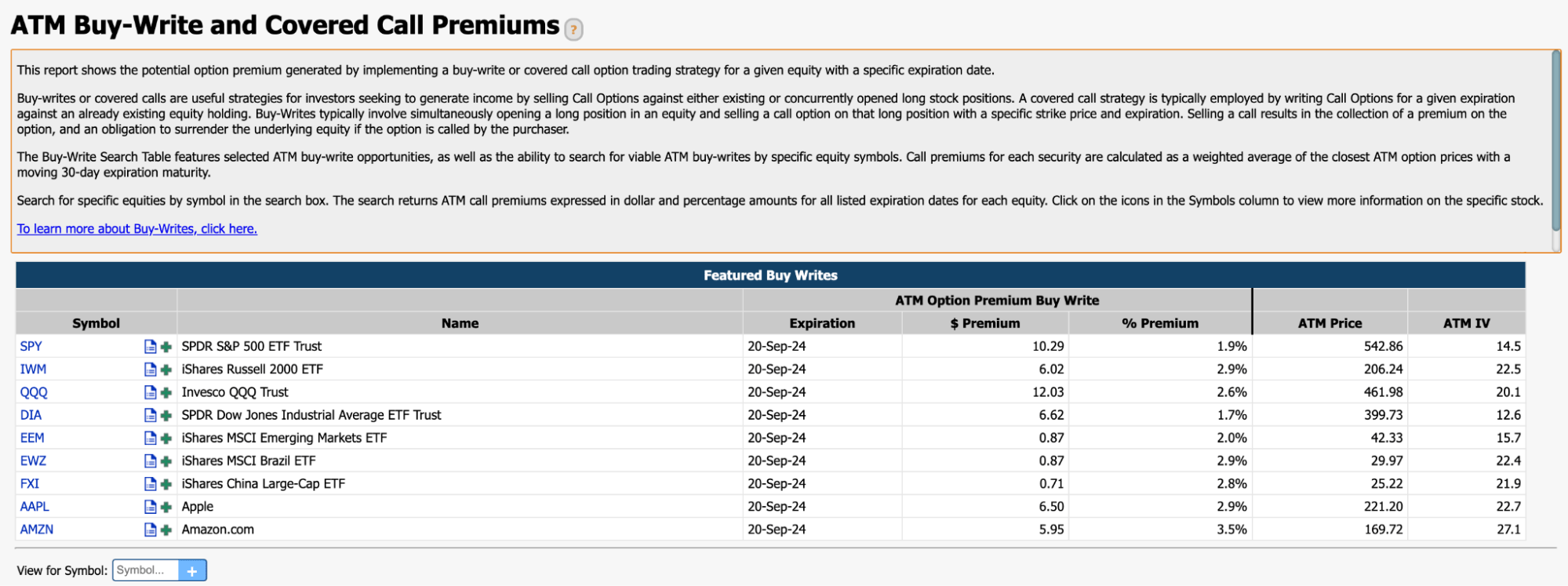
The site's Order Flow sections show which stocks traders are most bullish and bearish on, and can also give you a good idea of the market's general sentiment.
Plus, its Unusual Options Activity screener, which shows larger than normal orders, can be used to find interesting trade ideas.
As you can see, Market Chameleon has a host of tools for analyzing options. It's a great option if you're looking for a website where you can sift through the noise of the options market and identify specific trade opportunities.
3. tastytrade: Best brokerage for options trading
- Category: Brokerage
- Rating:
- Cost: Free, $1 per contract (on opening trades only)
tastytrade is hands-down the best brokerage for serious options traders.
The platform was built by the same team who created thinkorswim (#4 on this list), and this time they placed an even greater importance on giving high-volume options traders a great experience.
It has features likeportfolio risk analysis, an open API, liquidity ratings, and automatic P/L tracking of rolled options (you can ditch the spreadsheet you've been using).
Plus, the technology is top-notch. Every part of the website and app is streamlined, meaning fewer clicks and faster executions.
While the platform was primarily built for options traders, you can also buy U.S. stocks and ETFs, futures, options on futures, and cryptocurrencies.
Simply put, if you're an options trader, you won't find a brokerage with better technology, rates, and support.
4. thinkorswim: Most advanced options trading brokerage
- Category: Brokerage
- Rating:
- Cost: Free, $0.65 per contract (on open and close)
thinkorswim is the long-standing gold standard for trading platforms.
It was acquired by TD Ameritrade in 2009 (which was acquired by Charles Schwab in 2020) and quickly became a favorite for stocks, options, and futures traders. The platform makes it easy to chart, analyze, and place orders.
For options traders, thinkorswim provides real-time Level II data on order prints. You can add filters to this data to create your own options flow, similar to Market Chameleon's. You can also see in-depth options chains, probability analysis, and risk-reward profiles on options trades you're considering.
However, the platform is a bit outdated (in terms of UX and UI) and can be a bit cumbersome to use. For these reasons, I've placed tastytrade ahead of it on this list.
Anyone who has a Charles Schwab account (which you can create for free) can use all the tools thinkorswim has to offer. If you don't have a Schwab account, you can try thinkorswim for 30 days with a Guest Pass.
Looking for something simpler?
Robinhood is the simplest options trading brokerage. Its mobile app is extremely easy to use, it doesn't charge fees or commissions, and its options chains are incredibly intuitive. Robinhood also allows you to add options to a watchlist, a handy features I've yet to find on any other brokerage or platform.
Disclosure: This is an affiliate link. We may receive compensation if you take action through it.
5. LiveVol: Best for real-time options market activity
- Category: Research and analysis platform
- Rating:
- Cost: $128.95/month (for LiveVol Core, non-professional user plan)
LiveVol provides real-time market activity, time and sales data, statistics, and more to assist with your options trading.
The software was created by CBOE (Chicago Board Options Exchange), which runs the options exchange in the U.S., as well as many other exchanges around the world. In fact, it's the leading provider of derivatives exchanges.
Those credentials make it a pretty natural fit to run an options analysis software.
LiveVol breaks down its data into three categories:
- Market: Stocks, options, futures, trade tape, watchlist, earnings calendar, alerts
- Analytics: Time and sales, flow, news, volume, options calculator, scanners, fundamentals, earnings analysis, statistics
- Chart: Charts, graphs, skew
You're most likely interested in the Analytics section, which contains tools to help you analyze existing or potential positions, build and execute trades, and scan for setups.
For example, the Statistics tab is a dashboard for the current day's trading activity that gives you insight into market sentiment and how money is flowing.
LiveVol is primarily sold to professional traders and institutions, which is why its price is higher than the other software on this list.
6. IVolatility: Best options API
- Category: In-depth analysis software
- Rating:
- Cost: $79/month (for Builder plan)
If you're 50% trader, 50% engineer, this one's for you.
IVolatility is another platform that provides charts, options chains, intraday volatility visualizations, scanners, probability calculators, and risk analysis for options traders.
However, it's not because of any of these features that I included it on this list — it makes the list because of its data.
IVolatility provides data in two forms:
- Historical options data: Access comprehensive options and futures datasets with varying degrees of granularity. You can also get data on fixed income, interest rates, earnings, dividends, and more.
- API: Access all of the above data via an API call.
This data can be used to create your own machine learning and algorithmic trading strategies, backtesting, risk assessments, trading applications, market research websites, or anything else you can think of.
IVolatility has market coverage for the U.S., Asian, and European markets.
If you're wondering why someone would want access to this data and how they would even go about manipulating it, you can ignore this one — it's not for you.
Bonus tools
Here's a bonus list of a number of free tools I find myself referring to on a regular basis:
- Options Profit Calculator: Provides visualizations for modeling the potential profit/loss of different strategies at various closing prices.
- Cboe Trade Optimizer: Input a symbol, your sentiment, a target price, and an expiration date, and the tool will provide a number of potential strategies and their relevant stats.
- OptionStrat: Another option for visualizing profit, loss, and breakeven points. There is a paywall, but all of the profit/loss graphs (under the "Build" pulldown) are free.
- Robinhood: Mentioned this one above, but Robinhood is the only platform I've found where you can add option contracts to a watchlist and keep track of their profit and loss.
Other than those, I want to reiterate how good the options analysis tools are inside tastytrade and thinkorswim, and all you need to do to access them is open a brokerage account.
Final verdict
As you can tell from the list above, there are many types of options analysis software, each with its own value.
Some help you filter through stocks and find trade setups, others help you analyze risk and probabilities, and others allow you to build your own trading models based on the data they provide.
Hopefully, you've narrowed down the list to know what type of software you need.
The next step: Try one! Many of the tools on this list offer free trials or money-back guarantees, so there's no risk in testing it out.
Your litmus test for whether or not the software is worth it is pretty straightforward — does it make you a better, more profitable trader? If so, it's probably worth the cost.