.png)
The State of (Investing in) AI in 2026

Author's note: This began as a personal exercise, just jotting down notes and asking questions. I'm not an expert in AI or technology investing. I was just curious about the math. I'm not holding onto any of these ideas too tightly. Most likely, I'll be directionally correct about some things and completely wrong about others. Keep what you find useful and disregard what you don't.
AI is an extremely valuable technology.
This year at Stock Analysis, we're on pace to double the number of features we released in 2025. Including the countless backend improvements we've made, Cursor (an AI coding platform) has likely made our software engineers 4x more productive.
Said another way, AI has allowed us to produce the same amount of output as an engineering team 4x our size. At $100/hour per engineer, that's $400 of “savings” every hour, or $64,000/month.
Our Cursor bill is now over $10,000/month (and growing). We could probably cut it in half by using cheaper models or slower modes. But the relative cost savings don't matter too much when we're talking about $64,000/month in additional output, especially when we can scale that spend up or down almost instantly.
The point is, this is an absurd amount of value creation.
But “Is AI valuable?” and “Should we invest in AI today?” are not the same question. Just because you're bullish on the technology does not mean you must be bullish on the current investment cycle.
As of mid-2026, I see three major problems in the AI supply chain:
- Poor unit economics at scale
- Massive infrastructure commitments being are made ahead of proven end-user demand
- Products that may become increasingly commoditized over time
Together, those factors make investing in the model, cloud, or physical infrastructure layers incredibly risky.
Let's start at the beginning.
Disclaimer: This article is for informational and educational purposes only. It reflects the author's personal opinions, which do not necessarily represent the views of Stock Analysis. Nothing in this article should be considered investment advice or a recommendation to buy, sell, or hold any security.
The AI supply chain
In a healthy, mature supply chain, a customer puts a dollar in at the top, and some percentage of the dollar goes to each player in the chain.
In food delivery, for example, the customer buys dinner, DoorDash makes money, the Dasher makes money, the restaurant makes money, and so on down the entire chain. Everybody makes money, and the customer pays enough to support the whole thing. That's a healthy, mature supply chain.
The problem in AI right now is that for every $1 that comes in at the top, there's something like $1.60 in operating expenses. [1]
In 2025, OpenAI generated $13.1 billion in revenue and posted an operating loss of $8 billion, while Anthropic finished the year at a $9 billion run rate (that is, December's monthly revenue multiplied by twelve) and operating losses of around $5 billion.
That trend has continued in 2026, with OpenAI burning through $3.7 billion on $5.7 billion of revenue in the first quarter — both triple from the same period a year ago.
These unit economics aren't uncommon for startups, especially those building in new industries.
However, what's less common is a) the magnitude of these losses and b) the massive infrastructure build-out being made to support the (projected) demand.
I'll get to the infrastructure spend next, but one final note on the scale of losses and current unit economics:
OpenAI is now projecting losses of $25 billion in 2026 and $57 billion in 2027. For reference, only 79 companies in the S&P 500 generate more than $57 billion per year in revenue.
And, despite these losses, both OpenAI and Anthropic are considering price cuts as they compete with one another for new business.
AI's $900B hole
OpenAI plans to spend $665 billion on compute* by 2030. [2][3]
*Compute is the computer processing power required to build, train, and run AI models. There are two types: training (initial model learning, R&D expense) and inference (daily user requests, operating expense).
Assuming a 25% margin to break even, the lab would need to generate $885 billion in revenue by 2030, or $177 billion per year — about 13.5x the $13.1 billion it earned in 2025 and about 6x the $30 billion it's projecting for 2026. [4]
Clearly, there's a large gap between the revenue expectations implied by its compute commitments and the actual revenue being generated.
The problem gets worse when looking at the broader ecosystem.
Since Nvidia's GPUs are roughly half the cost of an AI data center (with the other half being energy, buildings, generators, etc.), we can use* Nvidia's Data Center run-rate revenue to understand how much total AI infrastructure is being built.
*I followed David Cahn's example for these calculations.
To start, we multiply Nvidia's Data Center run-rate revenue by 2x to calculate the total spend on AI data centers. Then, we multiply by 2x again to reflect a 50% gross margin for the end-user of the GPU (the business actually buying the compute, which needs to make money as well).
| (in billions) | Q4 2023* | Q4 2024* | Q4 2025* |
|---|---|---|---|
| Nvidia Data Center Run-Rate Revenue | $74 | $142 | $249 |
| Data Center Facility Build and Cost to Operate | 50% | 50% | 50% |
| Implied AI Data Center Spend | $147 | $284 | $498 |
| Software Margin | 50% | 50% | 50% |
| AI Revenue Required for Payback | $294 | $568 | $996 |
*Calendar years, not fiscal years. Q4 2023 = Nvidia's Q4 FY24, which ended January 28, 2024.
This implies that for each year of current GPU CapEx, nearly $1 trillion of lifetime revenue would need to be generated by these GPUs to pay back the upfront capital investment. This does not include any margin for the cloud vendors (the companies building the actual data centers).
As mentioned above, OpenAI generated $13.1 billion in 2025. Anthropic generated roughly $5 billion in revenue (the $9 billion figure was its year-end run rate). Microsoft probably generated around $15 billion from its AI products. Let's assume Google, Meta, and Apple did $10 billion each. And let's use a $5 billion placeholder each for Oracle, ByteDance, Tencent, X, and Tesla. And let's throw in another $10 billion to account for the rest of the players I'm not considering, plus some cushion. Add all of those up and we get about $100B in AI revenue.
You might think this is an imprecise way of measuring this, and you'd be right, but it really doesn't matter because the numbers aren't even close. There's a $900B+ hole that needs to be filled for each year of CapEx at today's levels.
Which raises the question: who's still funding the build-out?
Who's funding the build-out?
In supply chains, risks are transferred from suppliers, who need to build CapEx to manufacture products, upstream to their customers, who pay a margin that compensates for this capital expenditure over time.
As mentioned above, in healthy, mature supply chains, the end customer funds the entire supply chain.
In AI, by contrast, the end customer is not funding the supply chain. Rather, the supply chain is funding its own buildout in the hope that more paying customers will eventually arrive.
What's unique about this cycle, in addition to the sheer scale, is how the CapEx risk has shifted over time.
Back in 2024, it was the hyperscalers like Microsoft and Amazon that were taking on most of the early infrastructure risk. They bought and leased land, secured power, and purchased GPUs, using their balance sheets to fund the build-out.
That started to change in 2025. While Microsoft and Amazon continued spending heavily on AI infrastructure, they stopped trying to capture all of the demand for AI data centers.
That's when Oracle, CoreWeave, and a growing list of NeoClouds stepped in to absorb some of the leftover demand. But these companies, even combined, have much smaller balance sheets than Microsoft and Amazon.
So as the build-out continued to grow, the risk transferred further up the supply chain to the chip providers themselves. Nvidia, AMD, and Broadcom have all entered into major deals to support additional AI infrastructure.
Nvidia agreed to invest $10 billion in OpenAI for every 1 GW of new data centers, up to 10 GW. AMD is building 6 GW with OpenAI, in return for up to 10% in equity warrants. Broadcom is also building 10 GW with OpenAI.
The deals look something like this: Nvidia invests $10 billion in OpenAI, OpenAI commits to renting compute from Oracle, Oracle starts building a 1 GW data center and buys $35 billion worth of chips from Nvidia, and around we go. [5]
Increasingly, all of the deals are being quoted in GW instead of dollars — I think, in large part, to obfuscate just how much money is being spent.
To put the concept of a GW in perspective, a very big data center pre-AI used 50 MW of power, which means a single 1 GW AI data center is as big as 20 cloud data centers.
Given the construction cost of AI data centers is around $50 billion per GW, inclusive of chips and interconnect — and again assuming a 50% gross margin for the consumer of the compute (the application layer) — we can arrive at the lifetime revenue required to pay back these investments.
| 1 GW | 6 GW | 10 GW | 100 GW | 250 GW | |
|---|---|---|---|---|---|
| Data Center CapEx | $50B | $300B | $500B | $5T | $12.5T |
| Software Margin | 50% | 50% | 50% | 50% | 50% |
| AI Revenue Required for Payback | $100B | $600B | $1T | $10T | $25T |
The columns in the chart above reflect 1 GW (unit cost), 6 GW (size of the AMD deal), 10 GW (size of the Nvidia and Broadcom deals), and then 100 GW and 250 GW, which are estimates now being widely used for base case and bull case forecasts on what CapEx through 2030 could end up looking like. [6]
There's a clear reason why the CapEx risk is moving back up the supply chain: as the required investments have grown, fewer companies are willing to take on the risk, leaving chip providers as the only players with strong enough incentives to keep the build-out going.
Arguments in favor of the current build-out
Before getting to my own conclusions, I want to cover two of the most common arguments in favor of the current investment cycle.
“GPU capex is like building railroads”
I agree with this, but only to an extent. There are a couple of problems with this argument:
- Lack of pricing power: In the case of physical infrastructure build-outs like railroads, there is usually some kind of monopolistic pricing power. If you own the tracks between San Francisco and Los Angeles, you can likely charge whatever price you want because there aren't any other tracks laid between those two places. In the case of GPU data centers, there is much less pricing power. GPU computing is increasingly becoming a commodity, where prices are almost always competed down to marginal cost.
- Depreciation cycles: Semiconductors will continue to get better and better, which will lead to more rapid depreciation of last-generation chips. If the B100s purchased today are estimated to hold their value for 5–7 years, but next-generation chips are produced before then, AI data center owners will be forced to a) upgrade their chips early or b) lower their pricing. In either case, the ROI will shift dramatically. Again, this parallel doesn't exist for physical infrastructure like railroads, which does not follow any sort of “Moore's Law” technology curve.
“OpenAI is like Amazon in its early days”
A lot of people are drawing the comparison between OpenAI and Amazon, which spent years prioritizing growth over profitability and is now one of the biggest companies in the world.
It's a bad comparison.
Amazon spent money building warehouses, logistics networks, and (later) data centers. They were building assets. CapEx.
Although OpenAI is calling them “infrastructure” commitments, much of its spending is for rented compute, which is purely OpEx. [7]
The difference is that if Amazon had stopped spending, it still would have had a massive logistics network, whereas if OpenAI stops spending, the server lights go out immediately.
What needs to happen to make the build-out work
The current build-out has a few fundamental issues that need to be addressed before the supply chain can function properly long term.
First, OpenAI and Anthropic need to fix their unit economics. They need to start earning something like $1 for every $0.45 of compute (a 55% gross margin).
Anthropic may have actually done this in Q2, as it projected its first-ever quarterly operating profit (though it seems to have massaged the numbers). Still, it doesn't expect to become cash-flow positive until 2028. As mentioned earlier, OpenAI burned $3.7 billion in Q1 and expects another $111 billion in operating losses through 2030.
The model providers need to fix their unit economics with either higher average revenue per user (ARPU) — which they could do by increasing the paid-to-free user ratio, increasing pricing, or adding ads — or lower costs.
Second, once the model providers are generating revenue sustainably (> 55% gross margins) and the supply chain no longer requires outside funding, AI data center owners will need to generate enough revenue to cover their costs before their chips need to be replaced.
This means AI data centers lose if a) the model providers don't have enough cash (either from external funding or gross margins) to pay their contracts, b) their chips need to replaced before their investments become cash flow positive, or c) models become more efficient and require significantly less compute (this likely won't be an issue for a while, as demand is still much higher than supply). [8]
For these reasons, I expect the companies currently building AI data centers will have an exceptionally hard time generating a positive ROI on their current investments. [9]
The commoditization of LLMs
One of the biggest issues facing model providers is the interchangeability of AI models — i.e., how easy it is for a customer to switch from one LLM to another.
There are already six major AI companies that are reasonably similar for most users: ChatGPT, Claude, Gemini, Grok, Llama, and Deepseek.
While there are still some noticeable differences between models today, there will likely come a point where the underlying model does not make a meaningful difference for the vast majority of users, in which case the cheapest (or freest) model will be the most heavily used.
While some providers may continue competing at the cutting-edge (OpenAI and Anthropic), those that cannot will go all-in on efficiency.
We've already seen this happening, primarily among Chinese models, which have been clocking in at around 90% of the performance at a fraction of the compute cost (their lower prices have led to a sharp increase in adoption). SpaceXAI and Meta have also started emphasizing smaller, cheaper, and more efficient models.
In other words, while LLMs will be the critical backbone of many products, I expect them to become increasingly commoditized over time. [10][11]
What this means for investors
This doesn't mean AI isn't valuable. I think it's very clearly one of the most valuable technologies ever created.
Our job as investors is to figure out where that value is going to accrue — that is, which layer of the stack will capture the profits.
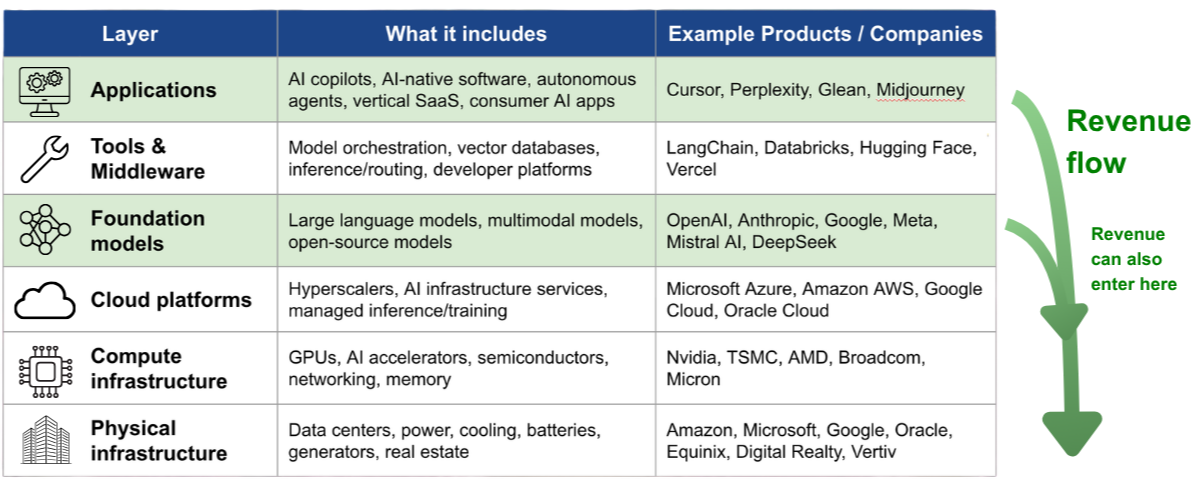
If a frontier model is meaningfully better than the rest of the market, consumers will likely pay a premium to access it. In that case, OpenAI, Anthropic, Google, or whoever has the best model, could take a large portion of the chain's value creation.
But if models are largely interchangeable, customers will likely use whichever model is cheapest, fastest, or most conveniently bundled into the products they already use.
Cloud computing is also interchangeable, almost by definition. One GPU cluster may be better located, better optimized, or more tightly integrated than another, but the underlying product is still compute. Unless supply remains extremely tight, it's hard to see how this layer could earn outsized margins over time.
If both the model and compute layers are commodity-like, then most of the value will accrue somewhere else.
The most obvious place is the application layer, the companies using AI to solve specific customer problems. Cursor is a good example. It doesn't need to own the best model or operate its own data center; it just needs to offer AI in a valuable way that a specific avatar is willing to pay for.
The other place is the end customer, both businesses (like Stock Analysis) and individuals (like you and me) who are using AI to increase output, reduce costs, and save time.
The entire investment thesis of AI ultimately rests on a question of pricing power: who can charge premium prices without losing customers to cheaper competitors?
In my mind, the answer to that question is a) frontier labs (possibly) or b) defensible applications, with whatever value they're unable to capture left to accrue to the end consumers of the compute. [12]
Conclusion
Like all technology waves, speculative investment frenzies often lead to high rates of capital incineration. I don't expect this cycle to be any different.
However, I suspect that the overbuilding of infrastructure will lead to a dramatic decrease in the marginal cost of AI workflows and new product development.
This is good news for the future consumers of compute, and good news for innovation, but bad news for AI data center builders and their investors.
If you're wondering how you should invest in AI, start thinking about who is best leveraging the technology to make people's lives better. Which companies are turning AI compute into defensible products that customers use every day and are willing to pay for?
Footnotes:
[1] In 2025, for every $1 in revenue OpenAI generated, it spent 57 cents on inference compute, $1.47 on training compute, and 56 cents on other costs — equivalent to $1.60 in operating expenses and $2.60 in total expenses per $1 of revenue.
[2] This is total compute, both inference (OpEx) and training (R&D).
[3] At one point, it was $1.4 trillion, but I guess that sounded too far-fetched.
[4] If OpenAI hits its $30 billion revenue goal for 2026, it will need to average ~$214 billion per year over the following 4 years to hit the $885 billion number.
[5] This is where the discussions over “circular financing” came from — chip companies providing the capital that then became their revenue.
[6] These numbers are also being used by AI leaders to describe their goals.
[7] Yes, some of this spend is going to training compute (R&D), which will have some residual value, but that doesn't do much good if the company is bankrupt.
[8] OpenAI did this recently, reportedly finding a way to halve inference costs.
[9] Although it will take longer to affect them, this will also be bad for chip providers.
[10] See here and here for more evidence. This is an especially bad problem because model providers currently need more pricing power, not less, if they want to become self-sustaining.
[11] If this is true, model providers won't be able to fix their unit economics with higher prices, so they'll need to fix them through efficiency gains.
[12] This is where I'm investing. Most relevant here, I have positions in CRM, MSFT, NOW, and IGV.