
Fisher Investments Review

If you're considering making Fisher Investments your financial advisor, you're not alone.
Thanks to its massive advertising efforts in the last 5 years, the firm now serves more than 200,000 individuals, businesses, and employees around the world and manages over $387 billion in assets.
But is Fisher Investments the right firm for you? And is it worth the fees?
Here's everything you need to know about Fisher Investments — including how it works, its fee structure, and what you can expect as a client — and whether it's the right firm for you. I also cover three alternatives you should consider before making your decision.
What is Fisher Investments?
Fisher Investments is an independent, fee-only fiduciary wealth management firm.
While it offers some 401(k) solutions and provides investing services for a few institutional investors, the firm primarily serves private clients (individual investors) through personal wealth management.
Fisher Investments was founded by Ken Fisher in 1979. Prior to launching his firm, Ken was an innovator in investment theory and wrote the "Portfolio Strategist" column for Forbes for 30+ years.
The firm is known for its personalized asset allocations, transparent fee structure, and active investment approach. It creates tailored investment mixes for each client and frequently adjusts client portfolios based on the firm's constantly evolving market outlook.*
*As you'll read later on, however, its "personalized" financial advice may not be all that personalized.
Fisher Investments is a fee-only firm, meaning it only makes money by charging a percentage fee on the assets it manages (more details on its fee structure below).
This is a good thing, as fee-only firms do not receive commissions for recommending certain products and are thus more likely to maintain their fiduciary responsibility to always work in your best interest.
Pros and cons summary
Here's a quick look at the pros and cons of Fisher Investments.
| Pros | Cons |
|---|---|
| ✅ Fee-only: It does not earn commissions for recommending certain products. | ❌ High fees: Its fees are higher than the industry average, typically around 1.25%. |
| ✅ Fiduciary: Its advisors are legally required to work in their clients' best interests. | ❌ Large-scale service model: Fisher serves a very large client base through a centralized investment and service structure, which may feel less personal than working with a smaller, local advisory firm. |
| ✅ Experienced investment committee: Its Investment Policy Committee (IPC) is highly experienced and takes an active investment approach, which could lead to outperformance. | ❌ Centralized investment framework: Fisher's investment management services fall into three broad account categories: equity, fixed income, and blended, based on each client's goals. While portfolios may be tailored to each client, the investment process appears to start from a centralized framework. |
| ❌ Ancillary services: Certain estate or tax-planning services may only be available through third parties and may be subject to separate charges from those providers. |
Keep reading for more details on each of these.
How does Fisher Investments work?
Target clientele
Fisher Investments targets high-net-worth individuals and those at or approaching retirement age.
The firm has a stated minimum requirement of $1,000,000 of investable assets, defined as any funds in brokerage, retirement, or cash accounts. That said, Fisher will take on clients with less than that on a case-by-case basis, though they will pay higher fees.
The firm also wants clients who agree with its long-term, goal-oriented investment philosophy, which I cover in more detail below.
Sales process
Fisher Investments runs a centralized sales organization, with dedicated representatives focused on inbound leads and ongoing follow-up.
After providing your contact information, you'll typically receive a call fairly quickly, followed by a structured sequence of emails and additional calls aimed at qualifying your assets, explaining the firm's approach, and moving you toward an account opening. The process often includes an introductory call, a deeper consultation, and portfolio discussions tailored to your situation.
Fisher's sales process is a serious operation and, though it can be a helpful way to gather more information, it's one of the most common complaints about the firm. Many prospects report frequent follow-ups and persistent outreach, which can feel overly sales-driven depending on your preferences.
New clients
Once aboard, new clients are assigned an Investment Counselor who they can meet with in person* or online.
*Fisher has offices in several U.S. states as well as a few global offices.
The Investment Counselor will be your main point of contact and will start by getting a general understanding of your financial situation.
From there, they'll set up an account for you, make an asset allocation recommendation, and implement that recommendation on your behalf.

Your Investment Counselor will then provide ongoing support and regular updates on changes in your portfolio.
Investment approach
Clients are given certain asset allocations based on their age, risk tolerance, current needs, and future objectives.
Generally, clients' accounts fall into the categories of:
- Equity (stocks and cash)
- Fixed income (fixed income and cash)
- Blended (combination of stocks, fixed income, and cash)
While this doesn't mean every client receives the same portfolio, it does suggest that Fisher provides investment management within a centralized framework, which may feel less customized than what some investors expect.
Investment Policy Committee
Unlike some fee-only advisors, Fisher takes an active management approach. Its Investment Policy Committee (IPC) monitors economic conditions and market sentiment to regularly devise new investment strategies and update its allocations.
For example, if the IPC determines international equities are undervalued, it may decide to tilt several of its growth strategies more heavily toward stocks outside of the U.S. These changes affect every account invested in that particular strategy at once.
In my opinion, if you're deciding whether or not to use Fisher Investments, the entire decision comes down to whether you have confidence in Fisher's IPC and want to use its models. More on this below.
Note: The company does not publicly disclose its strategies' returns.
Fee structure
Equity and Blended Accounts
Fisher Investments' fees are higher than the industry average.
It charges an annual fee — ranging from 1.00% to 1.50% — based on the total amount of assets it manages on your behalf.
Here's a look at Fisher's fees for clients with at least $1 million in assets:
| Assets | Annual management fee |
|---|---|
| First $1 million | 1.25% |
| Next $4 million | 1.125% |
| Additional amount over $5 million | 1.00% |
This is a progressive, bracketed fee structure (similar to the U.S. tax system). So, if you have a portfolio of $15 million, you will be charged:
- 1.25% on $1 million = $12,500
- 1.125% on $4 million = $45,000
- 1.00% on the remaining $10 million = $100,000
In this scenario, your total annual fee would be $157,500 (or 1.05%).
As mentioned above, Fisher Investments will take clients with less than $1 million of investable assets on a case-by-case basis.
The fees on these accounts are a flat 1.50% per year:
| Assets | Annual management fee |
|---|---|
| Up to $1 million | 1.50% |
Income-Only Accounts
Fisher Investments also offers income-only accounts to investors with more than $5 million in assets.
The fee structure on these accounts is:
| Assets | Annual management fee |
|---|---|
| First $5 million | 0.75% |
| Next $10 million | 0.50% |
| Next $10 million | 0.43% |
| Next $10 million | 0.38% |
| Next $10 million | 0.33% |
| Next $45 million | 0.28% |
These are also progressive and bracketed.
Other fees
Clients may also pay trading commissions or fees to third-party brokerage firms utilized to custody and make trades for their accounts.
Additionally, clients may incur other custodian fees and other expenses related to investing in exchange traded funds or structured notes.
None of these fees are paid to Fisher Investments.
Fees summary
Fisher Investments' annual management fees (ranging from 1.00% to 1.50%) are higher than the industry average, especially for those with large portfolios.
Most high-touch, fee-only financial advisors will charge 1.00% on the high end and as little as 0.40% (or less) for clients with over $10 million in investable assets. However, total cost depends on the advisor, the services included, and the underlying investment expenses.
Some investors may find Fisher's fee worthwhile to gain exposure to Fisher's active investment approach and other services, while others may decide the cost is harder to justify, especially if they are looking for a more bottom-up, planning-first advisory relationship.
A note on fee-only advisors:
Fisher Investments is a fee-only advisor, meaning it only makes money based on the value of your assets. This is what you want.
Other money managers (like Edward Jones) may earn both fees and commissions from investment products they place in your portfolio which can create a misalignment of incentives.
For example, if an advisor knows Product A is the best fit for your portfolio but will earn a $1,000 commission for using Product B, they may be tempted to use Product B to the detriment of your goals.
If you do choose to work with a financial advisor, be sure they are fee-only.
Why I don't recommend Fisher Investments
Although Fisher Investments does a lot of things right, in my opinion, its large-scale model makes it a poor fit for many people looking for a financial advisor.
Fisher is a massive company. It has over 6,300 employees, serves more than 200,000 clients, and runs a sophisticated national marketing and sales operation.
To me, the firm appears built around centralized client acquisition, standardized onboarding, and ongoing relationship management across a very large client base.
What does that model and scale mean for clients?
First, instead of interviewing and choosing a financial advisor, new Fisher clients are assigned an Investment Counselor. To me, that feels backwards. If you're hiring a financial advisor, you should be choosing someone you know, like, and trust, not having one assigned to you.
The second — and more important — issue is personalization.
Fisher Investments says it tailors portfolios to each client based on their goals and personal circumstances.
However, according to its ADV, Fisher provides investment management services within one of three broad account categories: equity, fixed income, and blended accounts. While that doesn't mean every client receives the same portfolio, Fisher's description of its account categories suggests to me that its process starts with a centralized investment framework, within which portfolios are tailored based on each client's specific circumstances, rather than constructing each portfolio entirely from scratch.
Fisher says it begins by understanding each client's full financial situation and goals. Even so, I prefer the approach taken by some smaller, higher-touch advisors, where the individual advisor may have greater responsibility and flexibility to construct client portfolios around their broader financial plans.
That difference in structure is not surprising given Fisher's size.
In my opinion, serving more than 200,000 clients may make it harder to provide the same depth of individualized planning available from some smaller, higher-touch firms. Fisher says its Investment Counselors are focused exclusively on client service and are supported by separate teams responsible for research, operations, financial planning, and other functions. That specialization may help it provide service at scale, but I prefer having a single advisor who is directly responsible for understanding, developing, and overseeing my entire financial plan.
Other online complaints from some former employees and clients (unverified) mention concerns about standardization (here, here, and here) and high portfolio turnover leading to large tax bills (here and here). These claims are anecdotal, but consistent with criticisms often directed at large-scale advisory firms.
To summarize this section: In my experience, large national advisory firms often operate in a more standardized way than many smaller, independent firms.
That does not make Fisher a scam, illegitimate, or a bad fit for everyone. It's a large, established, fee-only fiduciary firm with a lot of satisfied clients.
But if I were hiring a financial advisor, it's not the one I would choose. I believe many people would be better served by a smaller, planning-first advisor who they choose directly and who has greater responsibility and flexibility to construct and manage the portfolio around the client's broader financial plan. That is especially true for people with complex tax situations, concentrated stock, business ownership, real estate, charitable giving goals, estate planning needs, or retirement income questions.
Three alternatives to Fisher Investments
Here are three alternatives to Fisher Investments worth considering.
1. Traditional financial advisors
In my opinion, many independent financial advisors are much better options than Fisher Investments.
As mentioned above, Fisher Investments places each one of its clients into an investment strategy based on their age, risk tolerance, and portfolio size.
Good financial advisors, on the other hand, build a unique plan for each of their clients. These plans are highly customized to their clients' income needs, balance sheets, and financial goals.
In addition to investment management services, they may provide tax guidance, insurance recommendations, and advice on any real estate or other investments you may have — you get an advisor for your entire financial picture.
Plus, despite providing a much higher-touch service, they typically charge lower fees than Fisher (typically between 0.40-1.20%). This is especially true for high-net-worth clients, who may pay around 0.40% at a typical advisor (vs 1.00% at Fisher).
While I'm a proponent of self-directed online investing (next section), there are good reasons to choose a financial advisor instead:
- Convenience: If you have no interest in managing your money or simply don't want to spend the time, a good financial advisor is a great investment.
- Financial advice: While you can learn much of what your financial advisor knows, many advisors are experts in their fields. It can be invaluable to receive regular advice on your full financial life — estate planning, tax planning, insurance, charitable giving, and more — from an unbiased but interested third party.
- Emotional barrier: As you can see in the image below, most investors underperform the market because they are constantly jumping from asset to asset, chasing returns and selling at market lows. A financial advisor acts as a buffer between you and your money.
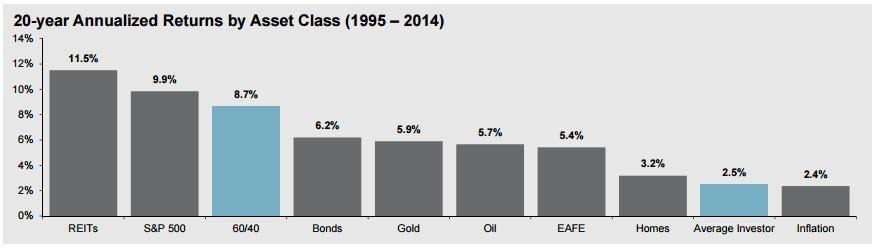
Source: J.P. Morgan Asset Management. This chart shows that the average investor earns returns of 2.5% per year, compared to 8.7% for a 60/40 portfolio or 9.9% for the S&P 500.
If you are going to use a financial advisor, find one that is fee-only and knows about tax planning. You want someone who will oversee your entire financial picture, not just your investments.
After meeting that criteria, find someone you like and trust. Interview multiple advisors and choose your favorite.
Scratch Capital is a fee-only financial advisor located in Boise, Idaho. The firm serves individuals and families across the US. I interviewed Scratch's founder, Drew Lunt, for this section of the article.
If you want to see what a more planning-focused advisory process looks like, you can request a free custom financial plan built by Drew's team by filling out this form.
Disclosure: This is an affiliate link. We may receive compensation if you take action through it.
2. Self-directed investing
If you talk to a financial advisor who is truly honest, they will tell you there's nothing they do that you can't do on your own, so long as you're willing to invest the time to educate yourself and are disciplined enough to stay calm during market volatility.
There are plenty of books, articles, videos, and other resources you can use to plan and manage your own retirement, and all will cost you a lot less than the 1%+ a financial advisor will charge.
A few of my favorite books are Simple Wealth, Inevitable Wealth by Nick Murray and The Psychology of Money by Morgan Housel.
Disclosure: This is an affiliate link. We may receive compensation if you take action through it.
Paying a 1% fee may not sound like much, but that's $10,000/year on a $1,000,000 portfolio (not to mention the cost of lost compound interest).
If you are at all interested in managing your own money, it can be one of the highest ROI skills to learn.
As for where to manage it, you can use either a free or paid portfolio tracker to get a good overview of your assets, returns, and net worth.
For example, Empower's free Financial Dashboard can help you aggregate your net worth and easily manage all of your investments in one place:
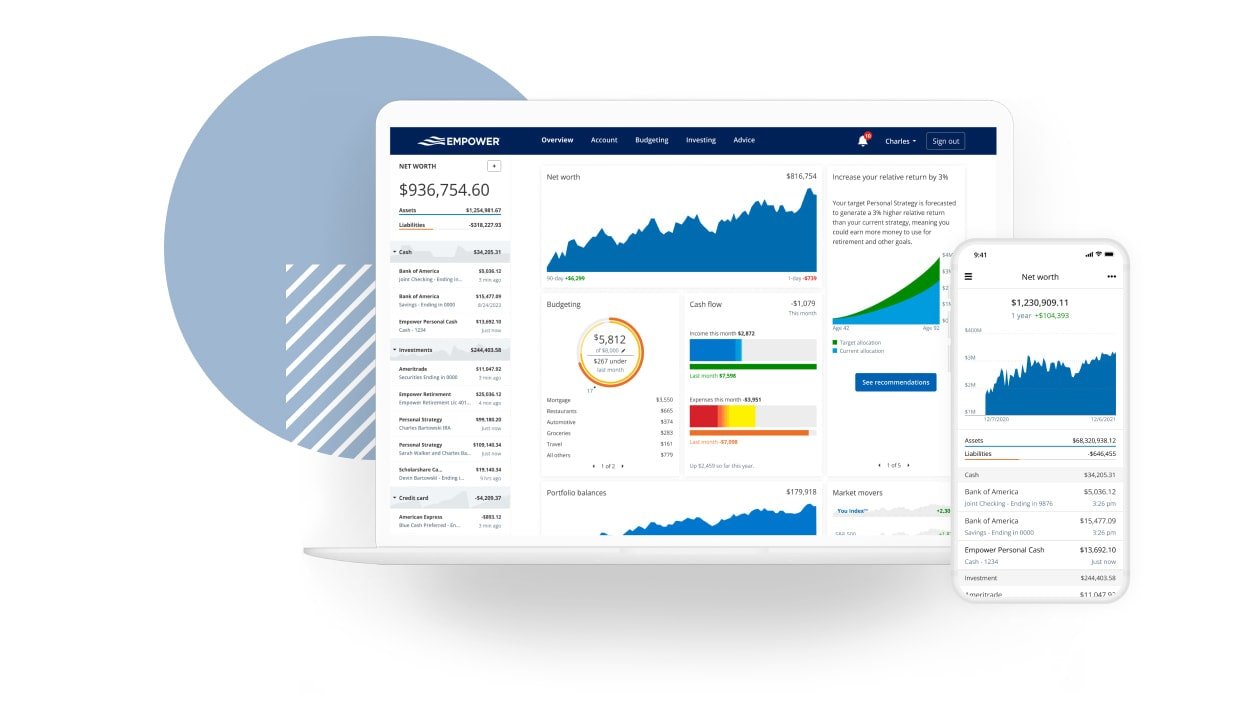
Empower also offers a Retirement Calculator, Investment Checkup, and more, all completely free.
Disclosure: This is an affiliate link. We may receive compensation if you take action through it.
3. Robo-advisors
Robo-advisors are computer algorithms that create portfolios based on your age, investment horizon, and future objectives.
While they won't offer tax or estate planning, they do a surprisingly good job of asset allocation and are also quite good at tax loss harvesting.
In short, they do at least 70% as well as a financial advisor for much lower fees, typically between 0.25–0.50%.
So, if you're young and your financial life is pretty simple, a robo-advisor may be the right option for you (I like Betterment).
However, if you have a larger net worth or are nearing retirement and want to take a hands-off approach, you should probably consider using a financial advisor.
Final verdict
Fisher Investments does a lot of things right. It's fee-only, acts as a fiduciary, has a long operating history, and manages money for a very large client base.
But I personally wouldn't use it.
By definition, firms that advertise heavily and serve hundreds of thousands of clients are operating at serious scale. That model can work well for some investors, but it's not usually the best fit for people who want highly individualized planning, tax guidance, estate coordination, and a direct relationship with an advisor they personally choose. For those people, a smaller independent financial advisor may be a better fit.
In my opinion, most people considering Fisher should also interview at least one or two independent, fee-only advisors before making a decision.
Frequently asked questions
Below are a few more questions people often ask about Fisher.
How trustworthy is Fisher Investments?
Fisher Investments has been in business for more than 45 years, has a large client base, and continues to grow. Reviews about the company are mixed, with some good and some bad, which isn’t uncommon for financial advisors.
Is Fisher Investments worth the fee?
This is a matter of opinion. I personally do not think it’s worth it, but many of Fisher’s clients are more than happy to pay the fees, which are slightly higher than the industry average, to gain access to its Investment Policy Committee and other financial planning services.
What is the average return on Fisher Investments?
The firm does not share performance data publicly, though it does disclose it uses the MSCI World Index for many of its private clients’ stock portfolios.
What do people say about Fisher Investments?
Fisher Investments has 2.2/5 stars on Trustpilot, which isn’t uncommon for financial advisors. However, it does have 200,000+ clients, so a lot of people are content with the level of service it provides.
How does Fisher Investments make money?
Fisher Investments is a fee-only advisor, which means it makes money by charging a percentage fee based on its clients’ assets.