
5 Ways to Invest in Pre-IPO Stocks

Pre-IPO investing offers the potential for enormous returns.
It's not uncommon for early-stage investments to 10x, 20x, or even 100x before a company reaches the public markets. Blackbird VC's first $3 million investment in Canva, for example, is now worth over $1.3 billion.
Of course, most of these investments don't turn out that way. Many lose money. But in venture investing, a single big winner can more than offset an otherwise mediocre portfolio.
Historically, investing in pre-IPO stocks required deep connections and millions of dollars. While those things still help, they're no longer prerequisites.
Today, it's easier than ever for individual investors to get exposure to private, pre-IPO companies.
This guide breaks down how pre-IPO investing works, the risks involved, and five ways you can invest in private companies before they go public.
What are pre-IPO stocks?
Pre-IPO stocks are private companies that haven't yet gone public through an IPO (initial public offering) or SPAC, but are expected to in the future.*
*Since private equity and venture capital firms invest with the goal of a large exit, going public is usually the final step in the process.
Until then, their shares are owned privately by founders, employees, and venture capital firms, private equity firms, and other private investors.
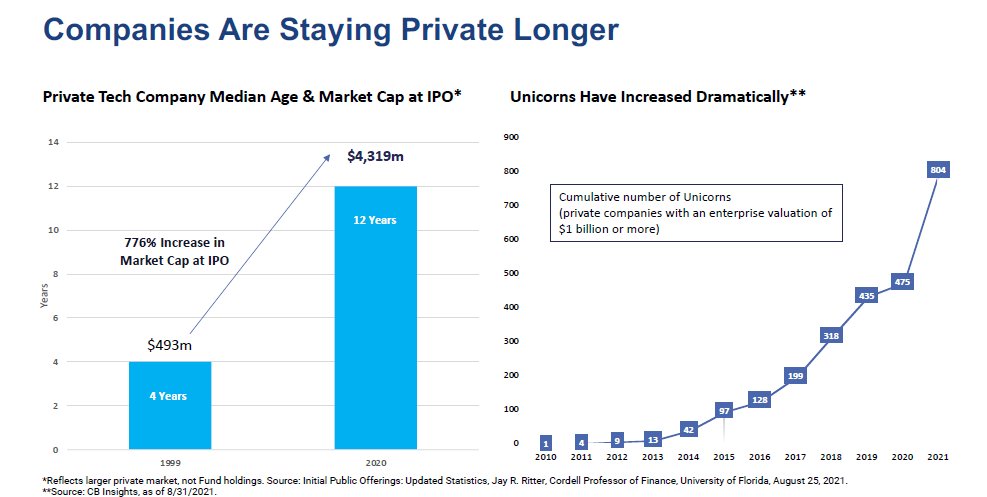
Over the last two decades, the pre-IPO landscape has changed dramatically.
Venture capital firms are now investing at earlier stages and with more capital than ever before. That influx of funding means startups can stay private much longer — and grow much larger — before hitting the public markets.
Source: ETF Trends
For companies like Microsoft, Apple, Amazon, and Google, going public was a critical milestone — an IPO was the primary way companies raised money to fuel growth.
Today, many top startups can raise billions of dollars privately before becoming publicly traded.
As a result, modern IPOs are less about raising capital and more about providing liquidity to founders, early employees, and private investors, usually at the expense of retail investors. They're liquidity events for insiders, not investment opportunities for the public.
That shift is the main reason investors are becoming increasingly interested in pre-IPO stocks. They want exposure earlier in the company lifecycle, before much of the growth and returns have already been captured.
Fortunately, individual investors now have more ways than ever to access private companies before they go public.
The 5 best ways to invest in pre-IPO shares
1. Buy shares on a pre-IPO marketplace
Thanks to regulatory changes, accredited investors* can now buy shares of pre-IPO companies.
*Accreditation requirements
To qualify as an accredited investor, you must meet one of the following criteria:
- Have an annual income of $200,000 individually or $300,000 jointly.
- Have a net worth that exceeds $1,000,000, excluding your main residence.
- Be a qualifying financial professional.
Secondary marketplaces connect potential buyers of private company stock with existing shareholders.
Sellers are typically current or former employees who have received stock grants, options, or other forms of equity as part of their compensation packages.
These shares can become quite valuable over time, but they're usually illiquid. An employee might hold shares worth millions of dollars but be unable to realize those gains.
That's where pre-IPO marketplaces come in. These platforms connect investors who want to buy private company stock with employees or other shareholders looking to sell their stock.
It's a win-win: shareholders get cash for their shares, and investors get equity in private startups they otherwise wouldn't have access to.
Some of the most popular platforms in this space include (in order of our recommendations from left to right):
| Hiive | Forge | Linqto | EquityZen | |
| Best for | Best overall | Liquidity | Fastest transactions | Fund offerings |
| Pros | Transparency, liquidity, & low fees | High trading volume | Speed & a low investment minimum | Several multi-company fund offerings |
| Cons | Mid-range investment minimum | Buyer fees & a high minimum | Highest costs | Few offerings & low liquidity |
| Companies available | 3,000+ | 5,100+ | ~85 | 450+ |
| Investment min. | $25,000 | $100,000 | $1,000 | $10,000 |
| Learn more | Learn more | Learn more | Learn more |
Disclosure: Some of these are affiliate links. We may receive compensation if you take action through them.
Each platform works a bit differently.
For instance, Hiive and Forge operate most like traditional marketplaces: sellers list their shares and asking prices, buyers place bids on those shares, and transactions are brokered once there's a match. Because of this, Hiive and Forge tend to have the most accurate and up-to-date prices.*
*For this reason, even if you end up buying on another platform, it's worth having accounts on both of these platforms to make sure you're getting the best price.
That said, company availability and pricing can vary across platforms. Many investors sign up for multiple marketplaces and evaluate deals on a case-by-case basis, choosing whichever platform offers the best terms for the specific company they're interested in.
Be sure to do your due diligence and familiarize yourself with each platform's fees and terms before investing.
Keep in mind: these platforms are for accredited investors only, and some are also restricted to U.S. investors.
2. Become an angel investor
Another way to invest in pre-IPO companies is by becoming an angel investor.
Angel investors are typically former entrepreneurs or executives who have money, connections, and expertise in a specific industry or category.
In most cases, angel investors get access to deals through their contacts — they either know somebody at the company, have a mutual connection with the founder, or are known as an industry expert.
Once a connection has been established, you can reach out to your contact and see if the company is open to investment.
Most angel checks range from $200,000 to $400,000, though the exact figures can vary significantly. Some deals are smaller, closer to $25K–$50K, while others run into the millions.
If you have the capital and the knowledge but lack the personal network, you could explore angel investing platforms like FundersClub and AngelList.
These sites offer curated deal flow for accredited investors and let you invest smaller amounts across multiple startups.
However, a word of warning: Many of the deals listed on these platforms have already been passed over by top-tier VCs, usually for good reason.
3. Invest in pre-IPO & venture capital funds
If you're not an accredited investor, or simply aren't interested in picking individual startups, you can also invest in pre-IPO and venture capital funds.
There are several publicly-traded VC funds, such as:
- Fundrise Innovation Fund* (VCX): The Innovation Fund invests in private, high-growth tech companies and holds stakes in Anthropic, Databricks, OpenAI, Anduril, Canva, and more.
- Stack Capital Group* (STCGF): Stack Capital Group specializes in mid- and late-stage investments. Its largest holdings are SpaceX and Canva.
- Destiny Tech100 Inc* (DXYZ): The Destiny Tech100 fund aims to invest in a portfolio of the top 100 venture-backed private technology companies. It currently owns 36 companies. Anthropic, SpaceX, and OpenAI are its 3 largest holdings.
- ERShares Private-Public Crossover ETF (XOVR): This ETF invests in both public and private companies. Other than SpaceX being its largest position at ~19%, the vast majority of its holdings are in public stocks.
*Note: These are closed-end funds and may trade at significant premiums or discounts to their NAVs.
You may also be interested in the ARK Venture Fund (ARKVX). The ARK Venture Fund invests in disruptive technology companies in both the public and private markets. Its top five holdings are SpaceX, OpenAI, Kalshi, Replit, and Ayar Labs. The fund has an expense ratio of 2.90%.
All of these funds are available to retail investors.
4. Make indirect investments
Another way to get exposure to pre-IPO startups is by investing in public companies that already own stakes in them.
Here are a few examples:
- Disney (DIS) owns 100% of Hulu. While you can't invest in Hulu directly, owning Disney stock gives you indirect exposure.
- Salesforce (CRM) participated in Databricks' Series G in 2021. Assuming a $200 million investment, its stake would be worth around $956 million today.
- Microsoft (MSFT) has invested $13 billion into OpenAI and owns 27% of the company.
The problem? These pre-IPO investments usually represent a tiny fraction of the public company's overall business.
Salesforce's $956 million Databricks stake, for example, is just 0.71% of its $135 billion market capitalization. Even if Databricks were to 10x, it would barely move the needle on Salesforce's stock price.
That said, if you already own these stocks or believe in the parent companies, these small stakes can offer some bonus exposure to high-growth startups. Just don't expect them to drive performance on their own.
5. Invest on the IPO date via your broker
In the hours leading up to an IPO, some brokerages offer a limited allocation of shares to their clients before the stock begins trading on public exchanges.
These shares are typically priced at the IPO offering price, which is set in advance of the first day of trading. If demand is high, buying at this price can be extremely profitable.
For instance, Figma (FIG) had an offering price of $33 and reached a high of $124 per share on its opening day.
I've seen IPO offerings on TradeStation, Robinhood, Webull, TD Ameritrade, Schwab, and Fidelity.
However, availability is limited, and most brokers prioritize clients with larger account balances or higher trading activity.
If you're a customer, your broker will typically notify you if you qualify for an upcoming IPO allocation.
Just keep in mind: demand often far exceeds supply, and even eligible investors may only receive a small portion of their requested shares.
Can anybody invest in shares of pre-IPO stock?
Yes, anybody can invest in shares of pre-IPO stock, though the type of investment varies.
- Accredited investors can get direct exposure to private companies by buying shares on secondary marketplaces, like Hiive and Forge.
- Angel investors can also get direct exposure to companies, though they need personal connections and millions of dollars of capital.
- Retail investors can invest in publicly-traded and privately-held venture funds, like the Fundrise Innovation Fund and the ARK Venture Fund, to get direct exposure to baskets of private companies. They can also get indirect exposure to individual companies by buying shares of public companies that have invested in those companies. However, retail investors cannot invest directly in specific pre-IPO companies.
So, while there are ways for everyone to invest in private companies, the best and most direct methods are still reserved for investors with the most money and connections.
Pros and cons of pre-IPO investing
| Pros | Cons |
| Potentially high returns | Highly speculative and risky |
| Diversification outside of traditional markets | May require accreditation status and/or connections |
| Limited liquidity, so you may have trouble selling your investment | |
| High capital requirements | |
| Limited financial information |
Final thoughts
Pre-IPO investing is more accessible than ever, but there are still challenges.
Opportunities are limited, information is scarce, and the risk of loss is high. Many startups fail, and even those that succeed may take years to generate meaningful returns.
That said, every industry giant was once a private company. For investors who can identify winners early, the upside can be enormous.
If you choose to invest, do so with caution. Approach each deal with healthy skepticism, and treat it as one piece of a broader, diversified portfolio.
Any views expressed here do not necessarily reflect the views of Hiive Markets Limited ("Hiive") or any of its affiliates. Stock Analysis is not a broker-dealer or investment adviser. This communication is for informational purposes only and is not a recommendation, solicitation, or research report relating to any investment strategy, security, or digital asset. All investments involve risk, including the potential loss of principal, and past performance does not guarantee future results. Additionally, there is no guarantee that any statements or opinions provided herein will prove to be correct. Stock Analysis may be compensated for user activity resulting from readers clicking on Hiive affiliate links. Hiive is a registered broker-dealer and a member of FINRA / SIPC. Find Hiive on BrokerCheck.